



In today’s evolving educational landscape, learning is no longer confined to textbooks and traditional classroom activities. Within the framework of the European project Explore Your Abilities, we’ve embraced a holistic, multi-sensory approach to teaching fundamental concepts. Our latest lesson plan, “Exploring Mathematics Through the Five Senses,” is a vibrant example of how movement, play, and sensory engagement can transform early math education into a dynamic and inclusive experience.
The Science Behind Sensory Learning
Sensory play is more than just fu, it’s foundational. Rooted in cognitive neuroscience and educational psychology, sensory activities stimulate multiple areas of the brain, laying the groundwork for complex skills such as critical thinking, problem-solving, and emotional regulation. When applied to subjects like mathematics, this kind of experiential learning makes abstract concepts tangible and accessible.
By engaging all five senses, students process information in deeper, more meaningful ways. They don’t just learn numbers, they feel them, see them, hear them, and move with them. This sensory immersion strengthens neural pathways and enhances memory retention, particularly in early childhood and special education settings.
Target Group and Objectives
This activity was designed for a small group of four children, making it ideal for focused, personalized learning. The session spans approximately 15 minutes and targets key mathematical concepts including:
- Counting from 1 to 10
- Classification and sorting
- Understanding sizes: big, small, and medium
- Developing observation and estimation skills
- Fostering joy through play and movement
The Sensory Math Obstacle Course
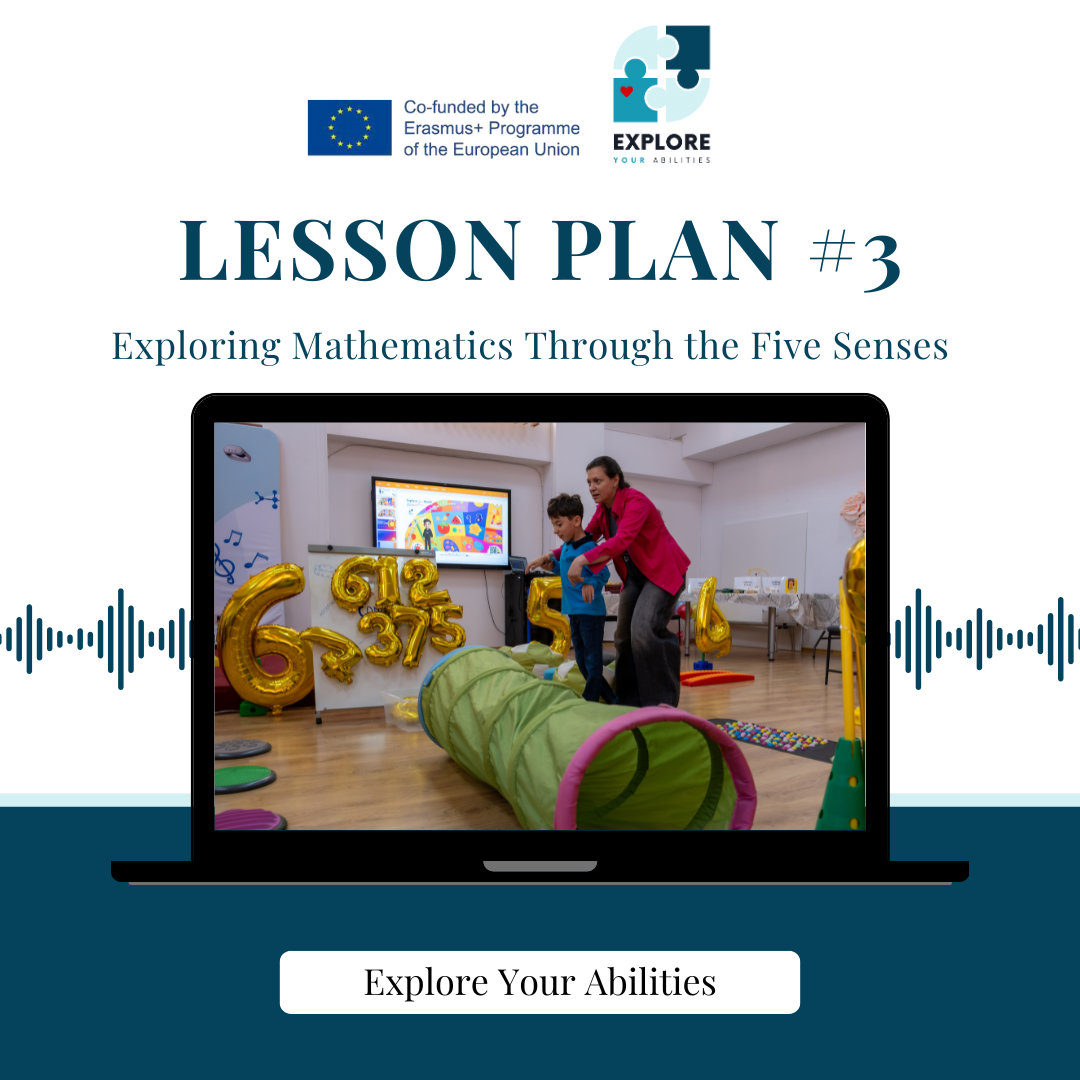
The central feature of this lesson is an indoor sensory obstacle course, a hands-on, movement-based experience designed to integrate numerical learning with physical and tactile exploration. Here’s how it unfolds:
1. Balance Beam Counting
Children walk along a balance beam, counting aloud from 1 to 10. This simple yet effective task combines physical coordination with numerical sequencing and concentration.
2. Spin-the-Wheel Numbers
Using a number roulette wheel, children spin to discover and recognize random digits. This builds number identification skills in a playful, game-like format.
3. The Hot Lava Jump
Soft puffs of different sizes simulate “hot lava.” Children are challenged to jump over them, using size comparison language like small, medium, and large. This encourages physical agility and conceptual differentiation.
4. Tactile Balloon Match
Children match balloon-shaped numbers to corresponding number cards on a board. This supports tactile discrimination and number recognition while promoting fine motor skills.
5. Tunnel Discovery
A crawling tunnel adventure leads to a puzzle clock at the other end. Children must use their sense of touch to navigate the tunnel, encouraging spatial awareness and exploration.
6. Building the Castle Wall
Using large LEGO bricks numbered 1 to 10, children work together to build a wall in numerical order. This promotes collaboration, sequencing, and structural thinking.
7. The Surprise Box
A transparent plastic bin filled with colored rice hides numbers from 1 to 10. Children dig with their hands to find and place them on a matching puzzle board, an exciting exercise in sensory integration and problem-solving.
All activities take place on textured sensory discs, adding another layer of tactile stimulation throughout the course.
Why It Works: STEAM and the Power of Play
This lesson is a perfect embodiment of the STEAM (Science, Technology, Engineering, Arts, Mathematics) methodology. It doesn’t just teach numbers, it experiences them. Integrating the senses into learning helps anchor abstract mathematical concepts in the real world.
Benefits of Sensory-Based Learning Activities:
- Enhances brain development through multisensory stimulation
- Builds motor skills (both fine and gross)
- Encourages vocabulary and language development
- Boosts cognitive growth and memory retention
- Strengthens social interaction and emotional self-regulation
- Encourages creativity, observation, anticipation, and estimation
Conclusion: Learning That Stays With You
The purpose of this activity goes far beyond mastering numbers. It’s about cultivating a love of learning, nurturing curiosity, and helping children develop essential life skills through joyful exploration.
When children are allowed to move, touch, listen, and interact with their environment, learning becomes not only more effective but also deeply engaging. By integrating STEAM principles with sensory play, we are not just teaching math, we are opening doors to a lifetime of discovery.