


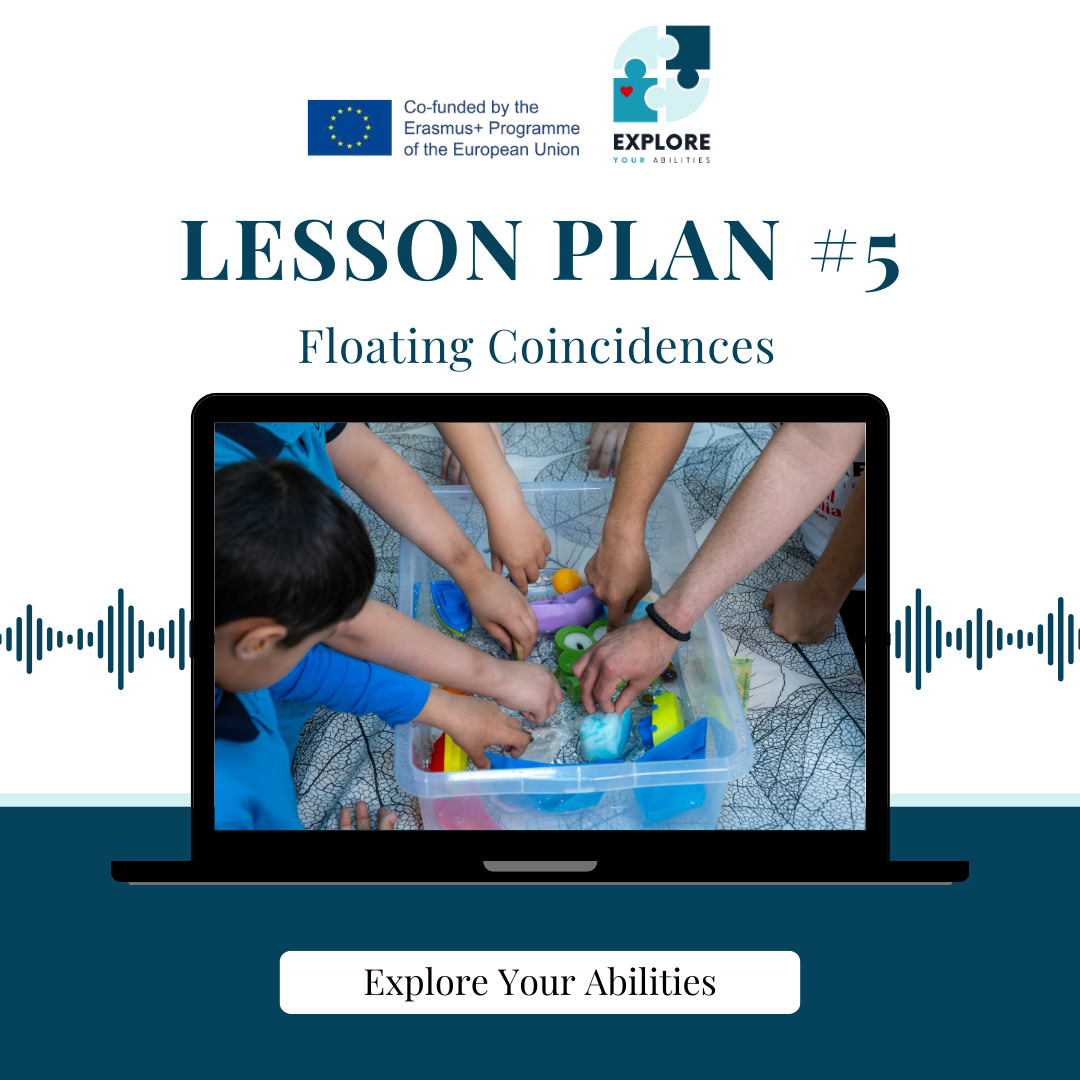
In the world of children’s education, few things spark curiosity like water, movement, and a little bit of mystery. Within the European project Explore Your Abilities, which aims to bring inclusive, creative, and exploratory learning into classrooms across Europe, we created a playful science activity called „Floating Coincidences”.
This mini-lesson, designed for children with diverse educational needs, uses hands-on exploration and storytelling to introduce the physics of floating and sinking, combining science with joy and imagination. It’s a great example of how STEAM education (Science, Technology, Engineering, Arts, and Mathematics) can be made accessible and engaging for all learners.
What We Learn: The Science Behind the Play
At the heart of this lesson lies a core scientific concept: buoyancy, the upward force that allows objects to float in water. Children learn that whether something floats or sinks depends on its weight, shape, and the amount of water it displaces. But rather than diving into theory, we invite children to think like scientists and act like explorers.
Learning Objectives
Adapted for early learners or children with additional needs, this activity focuses on:
- Observing whether objects float or sink.
- Making simple predictions: “I think it will sink.” / “I think it will float.”
- Associating properties with reactions: “This object is heavy – it sinks.”
- Enjoying discovery through playful, sensory learning.
Activity Structure: 20 Minutes of Discovery
1. Welcome and Introduction (3 minutes)
Children gather around a large clear container of water, seated in a circle.
The teacher introduces the activity with enthusiasm:
“Hello, my little explorers! Today, we have a secret mission, we’re becoming Water Detectives! We have a magic lake (shows the container of water) and lots of mysterious objects that want to take a bath. Some will float like boats, and others will sink like stones. Your mission: guess what will happen before we test it!”
The playful tone sets the stage for active participation.
2. Object Presentation and Predictions (5 minutes)
Each object (coin, sponge, plastic ball, etc.) is shown one by one.
The teacher asks:
“What do you think? Will it float or sink?”
Children vote by pointing up for float and down for sink, a simple, inclusive way to make predictions.
3. The Experiment (10 minutes)
One by one, children place the objects into the water, observing the result.
A designated “narrator” child says aloud:
“The coin… sank!”
“The sponge… floats!”
Reactions are encouraged, clapping, laughing, cheering, transforming the science lab into a stage of joyful discovery.
4. Conclusion and Reflection (2 minutes)
The group wraps up by discussing what they learned.
“What did we discover today?”
“Which objects floated?”
“What surprised you?”
These reflections help reinforce scientific thinking: observation, hypothesis, testing, and conclusion, all through play.
Materials Used
- A large, transparent rectangular container filled with water
- A coin
- Paper boats
- Plastic and glass balls
- A sponge
- Plastic bottle caps
- A small plastic boat
- Towels (for splashes and spills)
Why This Matters: Learning Through Experience
Children don’t learn science by memorizing definitions, they learn by doing. „Floating Coincidences” is a simple yet powerful example of experiential learning, where abstract physics becomes real through tactile, visual, and emotional engagement.
This activity aligns perfectly with the goals of the Explore Your Abilities project:
- Making science inclusive and playful
- Supporting cognitive and emotional development
- Encouraging observation, reasoning, and communication
- Cultivating joy, confidence, and curiosity in every child
Final Thought
This lesson isn’t just about floating or sinking, it’s about raising questions, inviting laughter, and building confidence in every child. By exploring buoyancy through storytelling and experimentation, we’re showing children that science is not something distant, it’s right here, in a bowl of water and a curious mind.So let’s keep asking:
“What do you think will happen?”
Because in that question lies the beginning of every scientific adventure.
This activity was created by Școala Gimnazială CONIL as part of the European project „Explore Your Abilities”, promoting inclusive STEAM education for all children.