



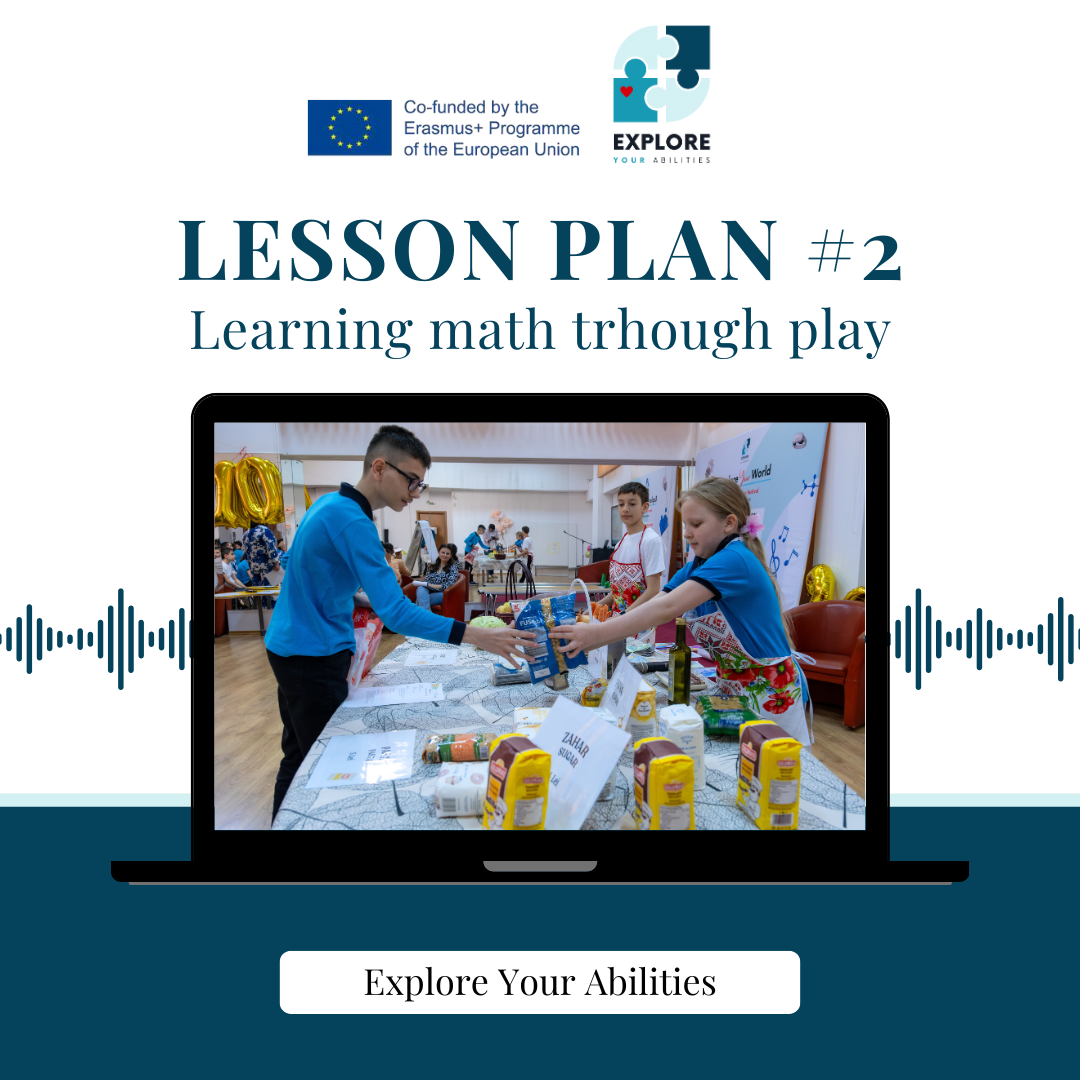
In the context of the European project Explore Your Abilities, which promotes inclusive STEAM learning for children of all abilities, a simple yet powerful idea emerged: what if we turned math into a game, and the classroom into a marketplace? That’s exactly what happened during the workshop „Math at the Market”, an engaging, interactive experience designed for primary school students, including those with special educational needs (SEN).
Why a Market?
The market setting provides a rich, familiar environment where children can naturally encounter mathematical concepts. It’s a world of numbers, prices, decisions, and interactions, all essential for real-life learning. From adding the cost of apples and pears to making change with toy money, children aren’t just solving problems, they’re living them.
Objectives of the Workshop
The main goals of the workshop were:
- To reinforce basic arithmetic operations (addition, subtraction, simple multiplication).
- To introduce children to the concepts of money, value, and negotiation.
- To foster teamwork and social interaction in a fun, low-pressure setting.
- To actively engage all participants, especially children with SEN, in a way that values their unique contributions.
Workshop Structure: 20 Minutes of Interactive Learning
1. Introduction (3 minutes)
A narrator opens the session with enthusiasm:
„Today, we’re going to the market! Let’s learn how to shop, count our money, and maybe strike a great deal!”
Children are introduced to the characters with simple accessories (aprons for vendors, baskets for shoppers). The tone is light, playful, and welcoming.
2. The Skit: “At the Market” (7 minutes)
A short theatrical performance brings the market to life. Five student actors take the stage: two vendors and three buyers, each with their own personality. The buyers make simple purchases, prompting live calculations.
Here’s where the magic happens: deliberate mistakes are introduced to encourage audience participation.
For example:
Vendor: “Three apples at 2 lei each… that’s 5 lei!”
Narrator: “Wait! Is that right? Let’s ask our audience!”
Children from the audience shout out the correct answer, becoming active problem-solvers rather than passive viewers.
3. Audience Involvement (7 minutes)
Children from the audience, especially those with SEN, are invited to participate directly. Using large visual cards with product images and prices, they choose items and calculate totals together with the “vendors.” Toy money and tactile materials make the experience multi-sensory and accessible.
4. Final Game & Reflection (3 minutes)
The narrator asks quick-fire math questions:
- “If one carrot costs 1 leu, how much are two?”
- “Who wants to tell us what they learned today?”
Children reflect, cheer each other on, and celebrate what they’ve learned through applause and playful energy.
STEAM in Action: More Than Just Math
While this workshop is rooted in mathematics, it aligns perfectly with the STEAM philosophy:
- Science – Through observation and structured reasoning.
- Technology – Optional tools like calculators or digital price tags.
- Engineering – Organizing and simulating systems (a market).
- Arts – Through storytelling, role-play, and performance.
- Mathematics – The core of the activity, practiced in a practical context.
The added value lies in the integration of these elements, creating a learning experience that is holistic, inclusive, and joyful.
Inclusive Learning: Supporting Children with SEN
This workshop is thoughtfully designed to support children with diverse needs:
- Visual aids: Large, clear product images and prices.
- Tactile tools: Toy money, baskets, physical interaction.
- Simplified speech: Clear, calm communication from all actors.
- Emotional support: Encouraging, non-judgmental guidance.
- Participation flexibility: Children may engage by pointing, showing, or choosing, not necessarily speaking.
Inclusivity isn’t an add-on, it’s the foundation!
What We Learned
„Math at the Market” proves that when learning is embedded in storytelling, play, and social interaction, it becomes both effective and meaningful. For children, especially those with SEN, such approaches create a space where they can thrive, not just survive.
The market becomes more than a place to buy and sell, it becomes a stage where every child is capable, confident, and celebrated.