


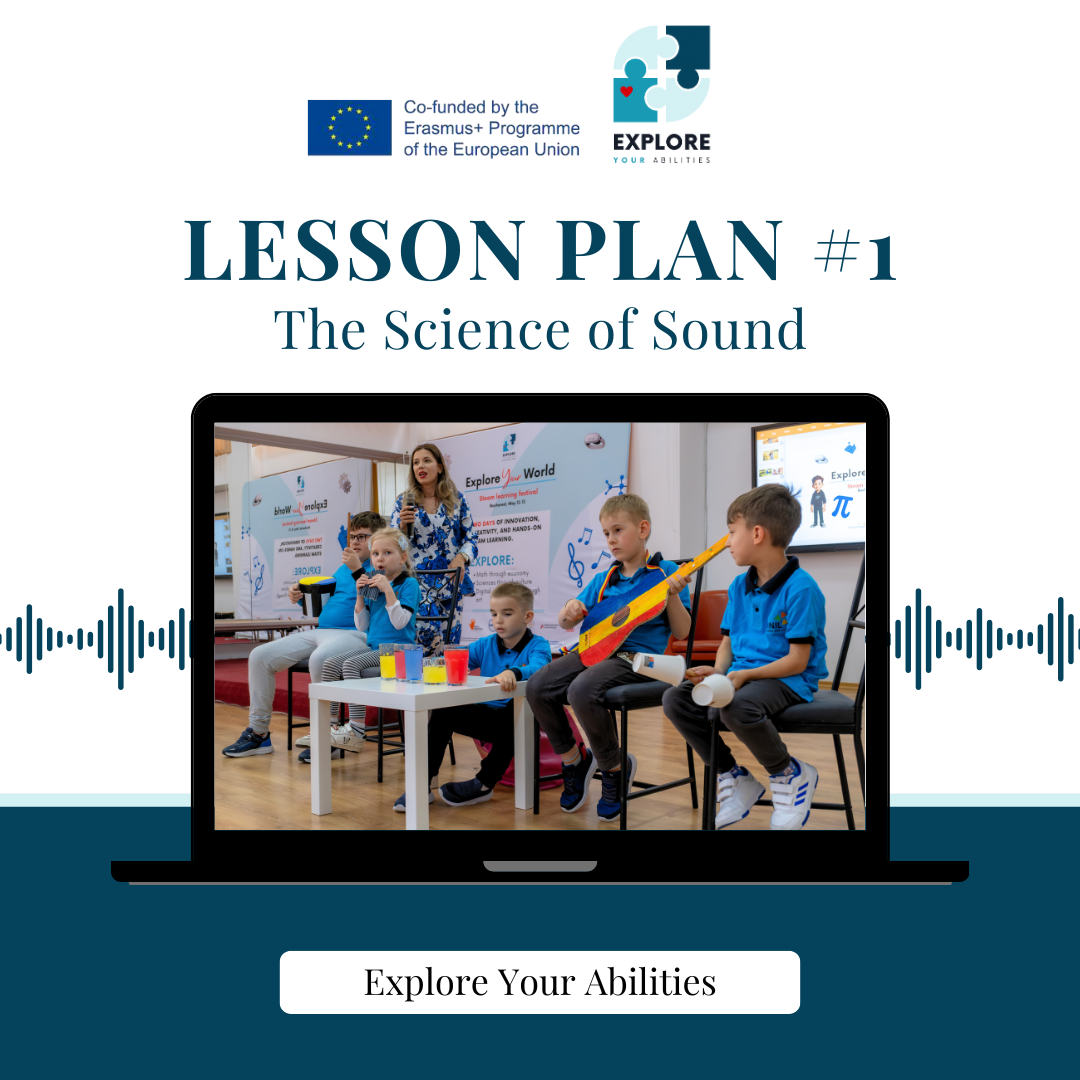
In the ever-evolving landscape of modern education, bridging the gap between creativity and science is more important than ever. This is the mission of the European project „Explore Your Abilities”, where learning becomes an exciting journey of discovery. One of our recent classroom experiences, „The Science of Music: Sounds from Science!”, perfectly encapsulates the spirit of STEAM education: integrating Science, Technology, Engineering, Arts, and Mathematics to develop essential 21st-century skills.
Let’s dive into this musical exploration and discover how simple household items can become powerful tools for learning physics.
Objective: Learning Science Through Sound
This 20-minute interactive lesson was designed for primary school children with one clear goal:
to explore how sound and music are created through simple experiments using everyday materials.
The session encouraged students to think like scientists and act like musicians — testing, observing, creating, and enjoying every step of the way.
The Science Behind the Music
Before jumping into the hands-on activities, the class started with a simple but engaging discussion:
What is sound? And what does it have to do with science?
Children learned that sound is a vibration that travels through air and reaches our ears. These vibrations, measured in frequency, determine whether a sound is low (bass) or high (treble). This introduction laid the foundation for understanding acoustics, the science of sound.
Visuals of musical instruments were shown, illustrating how sound can be produced by:
- Plucking strings (like on a guitar),
- Blowing air (like into a flute or straw),
- Striking surfaces (like a drum or glass).
The best part? Students didn’t just learn about sound, they made it.
Hands-On STEAM Activities
The following experiments were designed to show how scientific principles like vibration, frequency, and resonance are essential to making music:
1. Water Xylophone – Frequency in Action
Materials: 5 identical glass cups, water, metal spoon, (optional: food coloring for visual effect)
Activity:
Children filled each glass with a different amount of water. By gently tapping them with a spoon, they observed that each glass produced a different pitch.
Scientific Concept:
The more water in the glass, the slower the vibration — producing a lower sound. Less water means higher frequency and a higher pitch.
Bonus Challenge:
Play a simple melody like „Frère Jacques” using only the glasses!
2. Balloon Drums – The Power of Membranes
Materials: Plastic containers or jars, balloons, rubber bands, rice (optional for shaker effect)
Activity:
The round part of a balloon was cut and stretched over the container’s opening, then secured with a rubber band. Children tapped and shook their drums to create rhythms.
Scientific Concept:
Sound is produced when the stretched balloon surface vibrates. Adding rice inside transforms the drum into a maraca-style shaker, demonstrating sound from particle movement.
3. Straw Pan Flute – Length and Pitch
Materials: 5–7 straws, adhesive tape, scissors
Activity:
Children cut straws into different lengths and taped them side by side to form a pan flute.
Scientific Concept:
Longer straws produce lower sounds because the air vibrates more slowly. Shorter straws = faster vibrations = higher pitch.
4. Rubber Band Guitar – Tension and Thickness
Materials: Tissue or shoebox, rubber bands of different thicknesses
Activity:
Rubber bands were stretched over an open box and plucked to create sounds.
Scientific Concept:
Thicker bands vibrate more slowly and create lower sounds. Tight bands increase tension and raise the pitch, much like a real guitar!
5. DIY Maracas – Music from Motion
Materials: Small containers (e.g., plastic eggs or bottles), rice/beans/stones, glue or tape
Activity:
Children filled containers with small objects and sealed them, then shook them to produce rhythmic sounds.
Scientific Concept:
Sound results from the mechanical energy created when particles collide inside the container. This shows how motion can turn into music!
Why It Matters: STEAM in Action
This lesson isn’t just about making noise, it’s about making connections.
Children see firsthand how science and art are not separate worlds, but deeply intertwined. Music becomes a lens through which they can understand vibration, frequency, wave behavior, and even mathematical patterns. This cross-disciplinary experience promotes:
- Curiosity and experimentation
- Critical thinking
- Collaboration
- Creative problem-solving
Final Thoughts
As we wrapped up the activity, we left students with a powerful idea:
„Science is music. Music is physics, math, and above all, creativity.”
By bringing STEAM into the classroom through fun and accessible experiments, we’re not just teaching children facts, we’re helping them fall in love with learning.
If you want to inspire young minds and nurture their abilities, all it takes is a few cups of water, some straws, and the courage to make a little noise.
This activity was developed as part of the European project “Explore Your Abilities,” implemented by Școala Gimnazială CONIL, promoting inclusive and innovative education through STEAM-based learning.